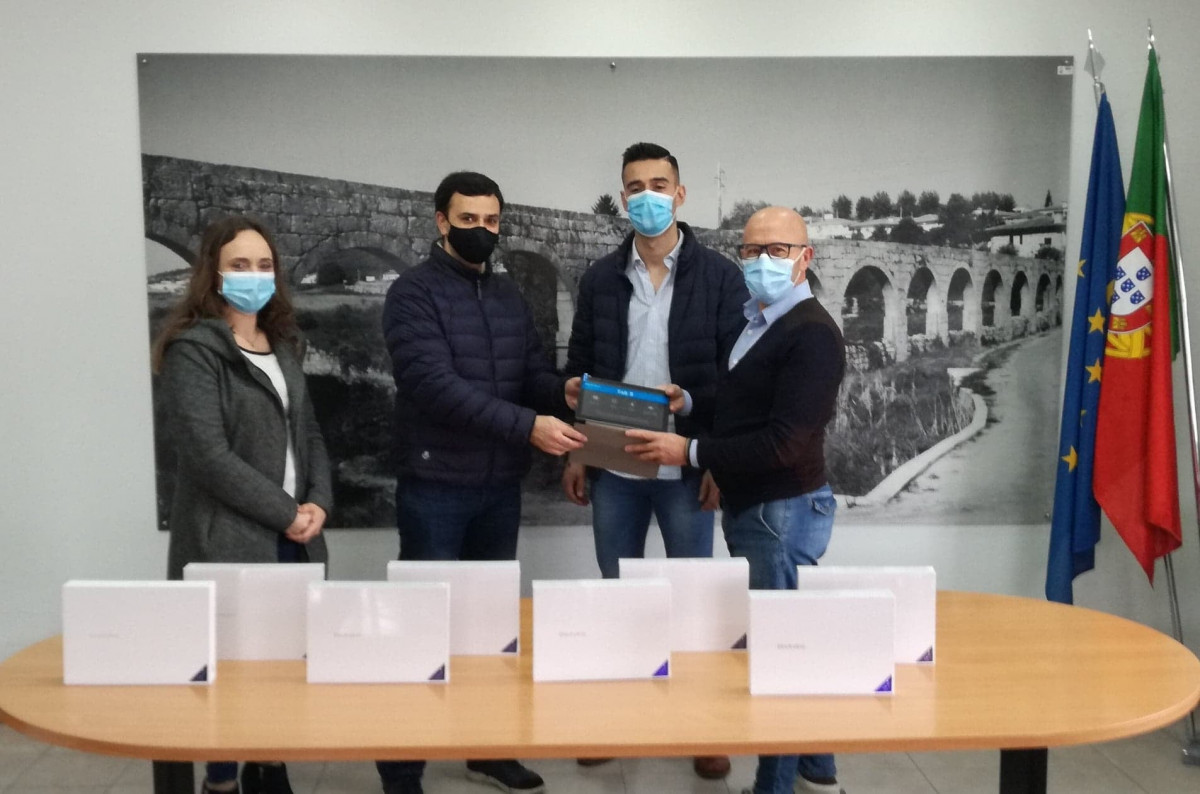
A Junta de Freguesia de Castelões, em colaboração com a Associação de Pais e Encarregados de Educação da Escola EB 1 de Castelões e Escola EB de Castelões e da empresa Infoplay, compraram oito tablets para a escola básica da freguesia.
O equipamento já foi entregue ao coordenador daquele estabelecimento de ensino e deverá, muito em breve, ser distribuído (em regime de empréstimo) pelos alunos que mais necessitem dele e não o possam adquirir.
O departamento de Cultura do Município de Famalicão leva à reunião de Câmara desta quinta-feira um pacote de subsídios para associações culturais do concelho no valor total de 202.500 euros.
Para a Fábrica da Igreja de Santa Marinha de Gondifelos vão 25 mil euros para o restauro do órgão de tubos da igreja; para vários grupos/ranchos folclóricos vai uma proposta total de 6 mil euros; para o Orfeão Famalicense são 2 mil euros e para a Tusefa 1500 euros; a Banda Marcial de Arnoso conta com 14 mil euros, o mesmo montante para a Banda Musical de Riba de Ave.
O INAC – Instituto Nacional de Artes do Circo poderá contar com 40 mil euros, destinado ao plano de atividades; o mesmo valor é proposto para o Teatro Didascália; a Companhia “Cão Danado” deverá receber 30 mil euros.
O Museu do Automóvel de Vila Nova de Famalicão tem proposta de 30 mil euros.
O Grupo Recreativo Amigos de Calça Ferros deu a conhecer os resultados do concurso online “Carnaval n`Aldeia Pedome 2021”, no qual participaram 70 candidatos. Os vencedores são os seguintes: categoria infantil: 1.º Carolina Silva, 2.º Martim Saraiva, 3.º Francisca; categoria adulto 1.º Fábio Oliveira, 2.º Ana Paula Neto, 3.º Elsa Lopes; categoria família 1.º Família Luna, 2.º Família Gonçalves, 3.º Família Margarida Barroso.
O concurso foi organizado pelo GRACAFE (Grupo Recreativo Amigos de Calça Ferros), em parceria com a Junta de Freguesia, exclusivamente online (na página do facebook), devido à pandemia. O objetivo foi dar oportunidade às pessoas de viverem o Carnaval sem deixarem de respeitar as regras do confinamento.
«Como Associação, estamos muito satisfeitos com o resultado e alcance deste concurso exclusivamente online, pois foi visto por 41122 pessoas. Através de 388 partilhas foram gerados 13772 “gostos” e 939 comentários», realçam.
O GRACAFE dá conta que 51% das interações foram no concelho de Vila Nova de Famalicão e mais de 80% em Portugal, mas também tiveram interações em Espanha, França, Suíça, Alemanha, Bélgica, Brasil, Luxemburgo, Guadalupe, Reino Unido e Brasil.
«Agradecemos a participação, empenho e entusiasmo que cada um imprimiu à sua participação, pois só assim foi possível termos o alcance que tivemos», afirma a organização.
Em resposta a questões enviadas pela agência Lusa, por correio eletrónico, o Comando-Geral da GNR explicou hoje que existem no país 86 PAR “com um atendimento ao público assegurado, regra geral, no horário entre as 09:00 e as 17:00”, com um efetivo que varia “até 12 militares por posto”.
Destes, “41 estão temporariamente suspensos e localizam-se nos distritos de Braga, Castelo Branco, Évora, Guarda e Portalegre”, indicou a mesma fonte, embora não tenha fornecido dados, solicitados pela Lusa, sobre o número de postos de atendimento encerrados temporariamente em cada distrito.
Segundo a GNR, trata-se de uma “medida temporária” e de “caráter dinâmico”, ou seja, “de acordo com a evolução das circunstâncias em cada momento”, mas o patrulhamento nas áreas destes 41 PAR “encontra-se garantido”, tal como “o apoio às populações”.
Esta “suspensão temporária da atividade de alguns postos territoriais, os quais já funcionavam em Regime de Atendimento Reduzido, teve como pressuposto as circunstâncias particulares e excecionais que o país atravessa, em especial a reposição do controlo de fronteiras terrestres”.
Uma tarefa que conta com o “forte empenhamento da Guarda Nacional Republicana”, frisou a força de segurança.
Foi considerado “operacionalmente vantajoso adotar esta medida temporária, a qual permite alocar um maior número de militares para o serviço operacional, nomeadamente para o controlo da fronteira terrestre”.
Mas a suspensão temporária “apenas vigorará enquanto se afigurar absolutamente necessário”, sendo retomada a “situação de normalidade logo que possível”, pode ler-se nos esclarecimentos enviado à Lusa.
Questionado recentemente sobre esta questão, quando esteve em Évora, na quinta-feira passada, o comandante-geral da GNR, o tenente-general Rui Clero, reconheceu que “a exigência do controlo de fronteiras 24 horas por dia veio também trazer uma exigência maior” e a Guarda procurou “adaptar os recursos disponíveis para melhor” responder a essa missão.
“Enquanto durar a questão do controlo de fronteiras, vamos ter esses postos de atendimento reduzido temporariamente encerrados, mas é uma situação que será revertida e que voltará à situação anterior logo que existam condições”, afiançou.
Para procurar tranquilizar as populações nessas áreas, o comandante-geral lembrou que “há um número de telefone para onde podem ligar” e, no caso de qualquer ocorrência, “é deslocada uma patrulha” e “o policiamento continua a ser garantido”.
O prolongamento deste prazo até ao final da semana surge depois de se terem verificado, ao longo do dia de hoje, alguns constrangimentos no acesso ao Portal das Finanças causados pelo elevado número de contribuintes que tentaram registar-se.
“Em face do significativo número de acessos ao Portal das Finanças durante o dia de hoje (tendo havido cerca de um milhão de autenticações), verificaram-se alguns constrangimentos de acesso à comunicação do agregado familiar”, disse à Lusa a mesma fonte oficial, acrescentando que a Autoridade Tributária e Aduaneira (AT) “continuará a aceitar a comunicação do agregado familiar até ao próximo dia 19 de fevereiro”.
A comunicação do agregado familiar tem de ser habitualmente feita até ao dia 15 de fevereiro, reportando-se à sua situação e composição em 31 de dezembro do ano anterior, sendo este um passo relevante no apuramento da situação fiscal dos contribuintes para efeitos do IRS ou do IMI, por exemplo.
O agregado familiar é ainda relevante para efeitos de obtenção de apoios sociais, bem como para o apuramento do enquadramento dos dependentes em guarda conjunta ou residência alternada.
Em resposta à Lusa a mesma fonte oficial referiu que, perante os constrangimentos detetados ao longo do dia de hoje, foi feita “uma intervenção ao nível da infraestrutura no Portal das Finanças, estabilizando o funcionamento do mesmo”.
A comunicação do agregado familiar é um dos primeiros passos na preparação da entrega da declaração anual do IRS, seguindo-se, até 25 de fevereiro, o prazo para o registo ou confirmação das faturas emitidas em 2020 bem como a resolução de pendências (o que acontece sempre que um estabelecimento tem mais do que um registo de atividade – CAE).
O calendário associado à campanha do IRS prevê ainda que entre 16 e 31 de março os contribuintes possam consultar as despesas dedutíveis e reclamar, caso detetem alguma omissão ou inexatidão nas despesas ou no seu cálculo, relativamente aos gastos gerais familiares e às despesas com direito à dedução do IVA pela exigência de fatura apurados pela AT.
Relativamente às despesas com educação ou saúde, lares ou habitação, os contribuintes podem corrigir os valores apurados pela AT aquando da entrega da declaração anual do IRS, indicando nessa altura os valores que consideram corretos através do Anexo H.
Esta possibilidade de o contribuinte recusar os valores apurados pela AT caso este não coincida com as faturas que tem na sua posse, implica que estas sejam guardadas durante pelo menos quatro anos.
Até 31 de março pode também ser indicada a entidade a quem se pretende consignar 0,5% do IRS liquidado e/ou o montante correspondente a 15% do IVA suportado em despesas com restaurantes, alojamentos, cabeleireiros, oficinas ou veterinários. Esta opção pode também ser feita aquando da entrega da declaração do IRS.
A entrega da declaração do IRS ocorre de 01 de abril a 30 de junho e o reembolso ou pagamento do imposto tem como data limite 31 de agosto.
O vereador da Câmara Municipal de Famalicão, Leonel Rocha, vai avançar com uma candidatura à Junta de Freguesia de Ribeirão nas eleições autárquicas deste ano. O autarca, natural da vila, aceitou o convite que lhe foi endereçado pelo presidente da Concelhia do PSD, Paulo Cunha.
Contactado pelo Cidade Hoje, Leonel Rocha confirma a sua disponibilidade para este novo desafio autárquico, não querendo, para já, prestar declarações. No entanto, sabe CH, que a Comissão Política Concelhia do PSD e o próprio Leonel Rocha darão, na próxima semana, mais informações sobre esta mudança.
Leonel Rocha é, atualmente, titular dos pelouros da Educação, Conhecimento e Cultura, e desempenha funções na Câmara Municipal desde 2002. Foi adjunto dos pelouros da Educação, Cultura, Desporto e Juventude entre 2002 e 2005. Entre 2005 e 2009 torna-se responsável pela pasta da Educação e da Cultura. Assume a vice-presidência da autarquia entre 2008 e 2009. Foi vereador da Educação e do Desporto, entre 2009 e 2013 e nesse ano assumiu a pasta da Educação, do Conhecimento e do Empreendedorismo.
Últimas Noticias
Concelho
Cookie Consent
We and our [number_of_vendors] partners use cookies and other tracking technologies to store and access information on your device and to process your personal data.
With your consent, we and our partners may process personal data such as unique identifiers, browsing data, and precise geolocation data, including through device scanning. You can accept or reject all by clicking the buttons below, or customize your choices by clicking "Manage Settings".
Some of our partners process your data based on their legitimate interest. You have the right to object to this processing. You can manage these settings by clicking "Manage Settings" and reviewing the legitimate interest options for each purpose and vendor.
This consent applies to this website only. You can withdraw or change your consent at any time by clicking the floating "Cookie Preferences" button at the bottom-left corner of your screen.
Data Processing Purposes: Store and/or access information on a device (397 seeking consent); Use limited data to select advertising (278 seeking consent, 96 using legitimate interest); Create profiles for personalised advertising (293 seeking consent); Use profiles to select personalised advertising (299 seeking consent); Create profiles to personalise content (114 seeking consent); Use profiles to select personalised content (107 seeking consent); Measure advertising performance (301 seeking consent, 131 using legitimate interest); Measure content performance (139 seeking consent, 55 using legitimate interest); Understand audiences through statistics or combinations of data from different sources (199 seeking consent, 67 using legitimate interest); Develop and improve services (200 seeking consent, 107 using legitimate interest); Use limited data to select content (62 seeking consent, 22 using legitimate interest)
Special Features: Use precise geolocation data; Identify devices based on information actively requested
Review and customize your consent choices for purposes and vendors. You can grant or withdraw consent for each purpose and vendor individually, or use the buttons below to accept or reject all.
The choices you make regarding the purposes and entities listed in this notice are saved in your browser's localStorage and a cookie named "wpconsent_tcstring" for a maximum duration of 12 months.
Non-IAB TCF Categories
These categories are not part of the IAB Transparency & Consent Framework.
Essential cookies enable basic functions and are necessary for the proper function of the website.
Name
Description
Duration
IAB TC String
This cookie stores the IAB Transparency & Consent Framework consent string, recording the user's choices for IAB TCF purposes and vendors.
12 months
Cookie Preferences
This cookie is used to store the user's cookie consent preferences.
30 days
IAB TCF Purposes
These purposes are part of the IAB Transparency & Consent Framework.
Store and/or access information on a device (397 seeking consent)
Cookies, device or similar online identifiers (e.g. login-based identifiers, randomly assigned identifiers, network based identifiers) together with other information (e.g. browser type and information, language, screen size, supported technologies etc.) can be stored or read on your device to recognise it each time it connects to an app or to a website, for one or several of the purposes presented here.
Examples:
Most purposes explained in this notice rely on the storage or accessing of information from your device when you use an app or visit a website. For example, a vendor or publisher might need to store a cookie on your device during your first visit on a website, to be able to recognise your device during your next visits (by accessing this cookie each time).
Use limited data to select advertising (278 seeking consent, 96 using legitimate interest)
Advertising presented to you on this service can be based on limited data, such as the website or app you are using, your non-precise location, your device type or which content you are (or have been) interacting with (for example, to limit the number of times an ad is presented to you).
Examples:
A car manufacturer wants to promote its electric vehicles to environmentally conscious users living in the city after office hours. The advertising is presented on a page with related content (such as an article on climate change actions) after 6:30 p.m. to users whose non-precise location suggests that they are in an urban zone.
A large producer of watercolour paints wants to carry out an online advertising campaign for its latest watercolour range, diversifying its audience to reach as many amateur and professional artists as possible and avoiding showing the ad next to mismatched content (for instance, articles about how to paint your house). The number of times that the ad has been presented to you is detected and limited, to avoid presenting it too often.
Create profiles for personalised advertising (293 seeking consent)
Information about your activity on this service (such as forms you submit, content you look at) can be stored and combined with other information about you (for example, information from your previous activity on this service and other websites or apps) or similar users. This is then used to build or improve a profile about you (that might include possible interests and personal aspects). Your profile can be used (also later) to present advertising that appears more relevant based on your possible interests by this and other entities.
Examples:
If you read several articles about the best bike accessories to buy, this information could be used to create a profile about your interest in bike accessories. Such a profile may be used or improved later on, on the same or a different website or app to present you with advertising for a particular bike accessory brand. If you also look at a configurator for a vehicle on a luxury car manufacturer website, this information could be combined with your interest in bikes to refine your profile and make an assumption that you are interested in luxury cycling gear.
An apparel company wishes to promote its new line of high-end baby clothes. It gets in touch with an agency that has a network of clients with high income customers (such as high-end supermarkets) and asks the agency to create profiles of young parents or couples who can be assumed to be wealthy and to have a new child, so that these can later be used to present advertising within partner apps based on those profiles.
Use profiles to select personalised advertising (299 seeking consent)
Advertising presented to you on this service can be based on your advertising profiles, which can reflect your activity on this service or other websites or apps (like the forms you submit, content you look at), possible interests and personal aspects.
Examples:
An online retailer wants to advertise a limited sale on running shoes. It wants to target advertising to users who previously looked at running shoes on its mobile app. Tracking technologies might be used to recognise that you have previously used the mobile app to consult running shoes, in order to present you with the corresponding advertisement on the app.
A profile created for personalised advertising in relation to a person having searched for bike accessories on a website can be used to present the relevant advertisement for bike accessories on a mobile app of another organisation.
Create profiles to personalise content (114 seeking consent)
Information about your activity on this service (for instance, forms you submit, non-advertising content you look at) can be stored and combined with other information about you (such as your previous activity on this service or other websites or apps) or similar users. This is then used to build or improve a profile about you (which might for example include possible interests and personal aspects). Your profile can be used (also later) to present content that appears more relevant based on your possible interests, such as by adapting the order in which content is shown to you, so that it is even easier for you to find content that matches your interests.
Examples:
You read several articles on how to build a treehouse on a social media platform. This information might be added to a profile to mark your interest in content related to outdoors as well as do-it-yourself guides (with the objective of allowing the personalisation of content, so that for example you are presented with more blog posts and articles on treehouses and wood cabins in the future).
You have viewed three videos on space exploration across different TV apps. An unrelated news platform with which you have had no contact builds a profile based on that viewing behaviour, marking space exploration as a topic of possible interest for other videos.
Use profiles to select personalised content (107 seeking consent)
Content presented to you on this service can be based on your content personalisation profiles, which can reflect your activity on this or other services (for instance, the forms you submit, content you look at), possible interests and personal aspects. This can for example be used to adapt the order in which content is shown to you, so that it is even easier for you to find (non-advertising) content that matches your interests.
Examples:
You read articles on vegetarian food on a social media platform and then use the cooking app of an unrelated company. The profile built about you on the social media platform will be used to present you vegetarian recipes on the welcome screen of the cooking app.
You have viewed three videos about rowing across different websites. An unrelated video sharing platform will recommend five other videos on rowing that may be of interest to you when you use your TV app, based on a profile built about you when you visited those different websites to watch online videos.
Measure advertising performance (301 seeking consent, 131 using legitimate interest)
Information regarding which advertising is presented to you and how you interact with it can be used to determine how well an advert has worked for you or other users and whether the goals of the advertising were reached. For instance, whether you saw an ad, whether you clicked on it, whether it led you to buy a product or visit a website, etc. This is very helpful to understand the relevance of advertising campaigns.
Examples:
You have clicked on an advertisement about a “black Friday” discount by an online shop on the website of a publisher and purchased a product. Your click will be linked to this purchase. Your interaction and that of other users will be measured to know how many clicks on the ad led to a purchase.
You are one of very few to have clicked on an advertisement about an “international appreciation day” discount by an online gift shop within the app of a publisher. The publisher wants to have reports to understand how often a specific ad placement within the app, and notably the “international appreciation day” ad, has been viewed or clicked by you and other users, in order to help the publisher and its partners (such as agencies) optimise ad placements.
Measure content performance (139 seeking consent, 55 using legitimate interest)
Information regarding which content is presented to you and how you interact with it can be used to determine whether the (non-advertising) content e.g. reached its intended audience and matched your interests. For instance, whether you read an article, watch a video, listen to a podcast or look at a product description, how long you spent on this service and the web pages you visit etc. This is very helpful to understand the relevance of (non-advertising) content that is shown to you.
Examples:
You have read a blog post about hiking on a mobile app of a publisher and followed a link to a recommended and related post. Your interactions will be recorded as showing that the initial hiking post was useful to you and that it was successful in interesting you in the related post. This will be measured to know whether to produce more posts on hiking in the future and where to place them on the home screen of the mobile app.
You were presented a video on fashion trends, but you and several other users stopped watching after 30 seconds. This information is then used to evaluate the right length of future videos on fashion trends.
Understand audiences through statistics or combinations of data from different sources (199 seeking consent, 67 using legitimate interest)
Reports can be generated based on the combination of data sets (like user profiles, statistics, market research, analytics data) regarding your interactions and those of other users with advertising or (non-advertising) content to identify common characteristics (for instance, to determine which target audiences are more receptive to an ad campaign or to certain contents).
Examples:
The owner of an online bookstore wants commercial reporting showing the proportion of visitors who consulted and left its site without buying, or consulted and bought the last celebrity autobiography of the month, as well as the average age and the male/female distribution of each category. Data relating to your navigation on its site and to your personal characteristics is then used and combined with other such data to produce these statistics.
An advertiser wants to better understand the type of audience interacting with its adverts. It calls upon a research institute to compare the characteristics of users who interacted with the ad with typical attributes of users of similar platforms, across different devices. This comparison reveals to the advertiser that its ad audience is mainly accessing the adverts through mobile devices and is likely in the 45-60 age range.
Develop and improve services (200 seeking consent, 107 using legitimate interest)
Information about your activity on this service, such as your interaction with ads or content, can be very helpful to improve products and services and to build new products and services based on user interactions, the type of audience, etc. This specific purpose does not include the development or improvement of user profiles and identifiers.
Examples:
A technology platform working with a social media provider notices a growth in mobile app users, and sees based on their profiles that many of them are connecting through mobile connections. It uses a new technology to deliver ads that are formatted for mobile devices and that are low-bandwidth, to improve their performance.
An advertiser is looking for a way to display ads on a new type of consumer device. It collects information regarding the way users interact with this new kind of device to determine whether it can build a new mechanism for displaying advertising on this type of device.
Use limited data to select content (62 seeking consent, 22 using legitimate interest)
Content presented to you on this service can be based on limited data, such as the website or app you are using, your non-precise location, your device type, or which content you are (or have been) interacting with (for example, to limit the number of times a video or an article is presented to you).
Examples:
A travel magazine has published an article on its website about the new online courses proposed by a language school, to improve travelling experiences abroad. The school’s blog posts are inserted directly at the bottom of the page, and selected on the basis of your non-precise location (for instance, blog posts explaining the course curriculum for different languages than the language of the country you are situated in).
A sports news mobile app has started a new section of articles covering the most recent football games. Each article includes videos hosted by a separate streaming platform showcasing the highlights of each match. If you fast-forward a video, this information may be used to select a shorter video to play next.